
Clay County Traffic Warrants Explained
A traffic citation in Clay County is a court matter from the day it is issued. The official Clay Traffic Court instructions say a person cited by a state trooper or county officer must answer in Clay County District Court. The date printed on the ticket is the appearance date, not the trial date. A person who wants to plead not guilty must appear and ask for a trial. If the ticket is not paid or otherwise disposed of before that date, and the person does not appear, the court may issue a warrant.
The same missed date may lead to more than one court or state consequence. Clay County warns that the fine may rise, a posted bond may be forfeited, and ALEA may suspend the license after court notice. Those steps do not all mean the same thing, and resolving one does not prove the rest have closed. The court that holds the citation remains the source for the current case and traffic warrant status.
The official Clay County traffic warning and payment routes appear in the court source shown below.
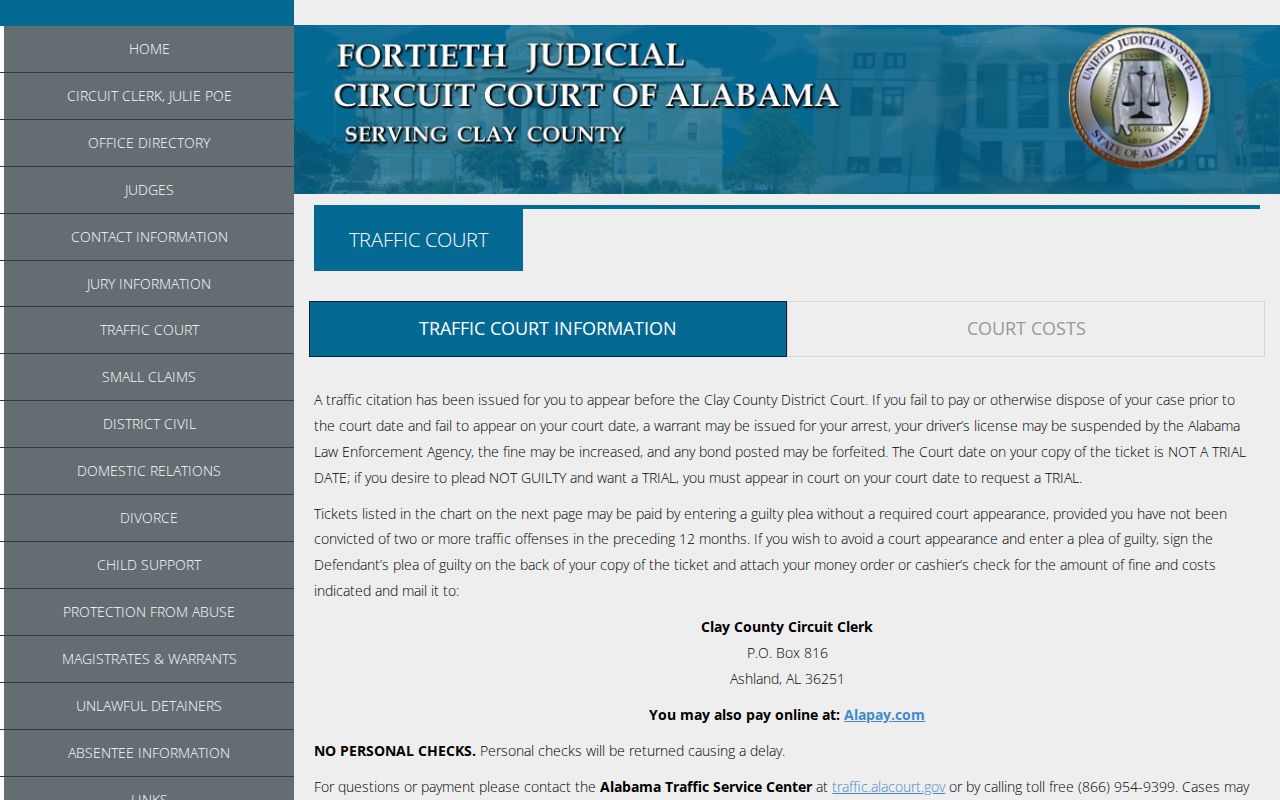
The court's warning ties a missed response to a possible warrant. It points readers back to the Clay County court itself, not to any general warrant list.
Clay County Traffic Warrant Court Route
Where the ticket was written sets the route. State trooper and county deputy citations go to Clay County District Court. Ashland Police tickets land in Ashland Municipal Court. Lineville city tickets stay in Lineville Municipal Court. Clay County's warrant magistrate skips both city dockets entirely. That split shapes any warrant check, because no single portal merges all Clay County traffic warrants and a deputy's case will never surface in a city search. Call the right clerk. The Circuit Clerk takes district traffic and warrant questions at 256-354-7926 or 256-252-4193. Ashland Municipal Court answers at 256-354-2112 and runs its own city-linked citation page. Lineville Municipal Court uses 256-396-2632 and a separate search portal. Unsure of the venue? Read the ticket header, note the citing agency and city, and ask that clerk whether the court holds the case. Never pay a city ticket through the district court just because it arose inside Clay County. The correct clerk must tie the payment, court date, and any warrant action to the same case.
Checking for a Traffic Warrant
A solid Clay County warrant check takes three things: the ticket, the official portal for its court, and confirmation from the clerk. Keep your full legal name, date of birth, ticket or case number, citing agency, and missed court date ready. Those details help a clerk tell similar records apart. Clay County publishes no sheriff traffic-warrant form. Nor does it promise clearance by phone.
- Identify Clay District Court, Ashland Municipal Court, or Lineville Municipal Court as the issuing venue from the citation.
- For a county or state ticket, test eligibility through the Alabama Traffic Service Center or Online Traffic Resolution with the ticket or case number and birth information.
- For Ashland, use the city-linked nCourt citation path or call 256-354-2112. For Lineville, use the Government Portal or call 256-396-2632.
- Ask the issuing clerk whether a warrant or writ is active, whether a new date or payment is allowed, and what proof will show that it was recalled.
- If a county arrest warrant is suspected beyond the citation record, follow Clay County's official instruction to appear at the Sheriff's Department in person. A sheriff records request may cover releasable served records, but an unserved arrest warrant is not public.
The Clay County clerk's public-access computer, plus eligible trial-court records in Just One Look, can add docket detail. Only the issuing court can answer for an open warrant.
Clay County Traffic Warrant Portal Fields
The state traffic system resolves cases; it is not a public list of Clay County traffic warrants. The Online Traffic Resolution portal asks for a ticket or case number first. Your birth month and year come next. County selection and later controls depend on the case. Your full legal name serves as the signature when the system submits a request to the court.
| Field or control | Use | Limit |
|---|---|---|
| Ticket or case number | Finds the court citation | Required to begin |
| Month and year of birth | Matches the cited person | Not a general name search |
| County choice | Routes the citation to Clay | Shown only where needed |
| Case options | Displays action the court may accept | Varies by charge and date |
The state traffic service page lists its ticket fields. It warns that failure to appear can lead to a Clay County warrant.
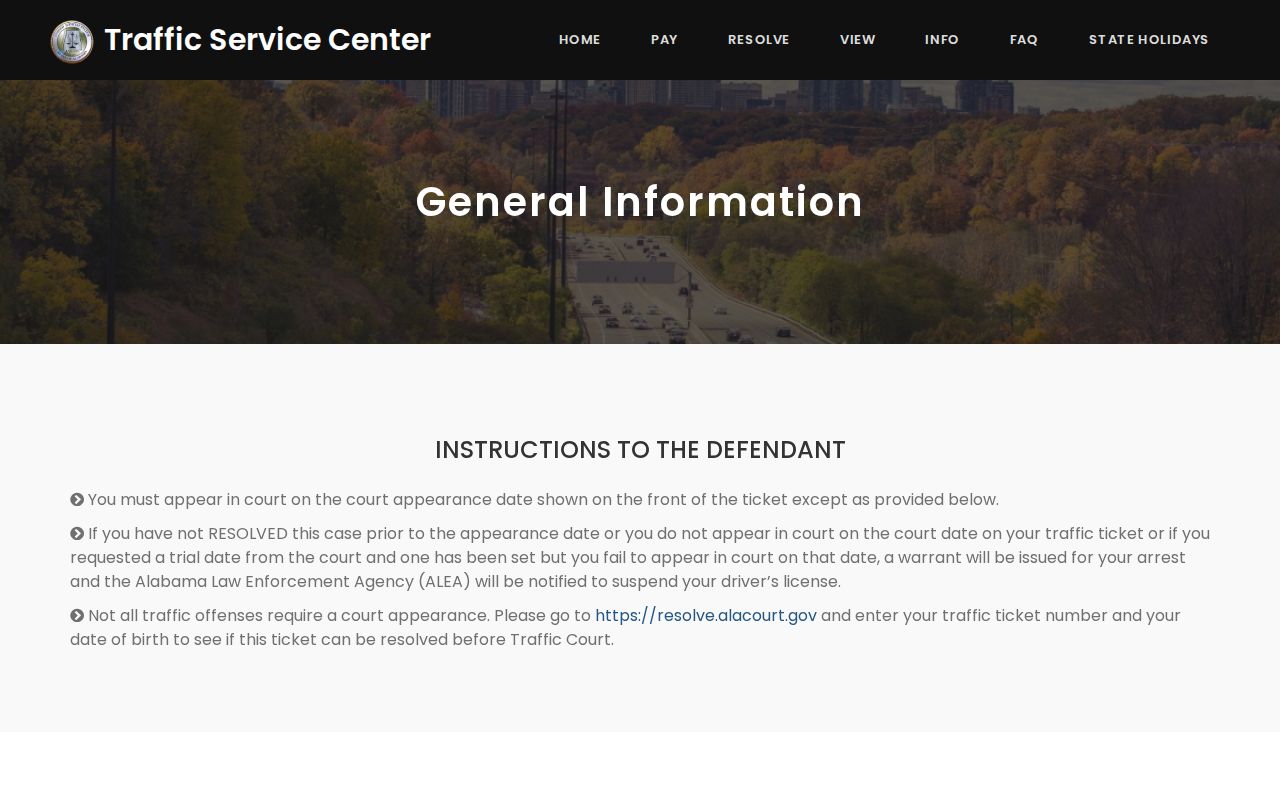
The portal helps route a known ticket in Clay County. It cannot promise that every piece of process tied to that ticket has been lifted. Only the court can say that.
Inside a Traffic Warrant Record
A traffic warrant record is read with its citation. Start with the identifier and the court. In Clay County, compare the required appearance date, the case status, any amounts due, and later orders next. Clay County has published no special traffic-warrant number pattern. So do not guess at a sample format; use the exact ticket or case number printed by the court.
| Ticket or case number | The court's identifier for the traffic case; no separate Clay format is published. |
|---|---|
| Issuing court | Clay District Court, Ashland Municipal Court, or Lineville Municipal Court. |
| Offense and court date | The cited act and the date by which the person must pay, resolve, or appear. |
| Amount and disposition | Fine, court costs, payment state, or court action shown for the citation. |
| FTA or warrant state | An active-warrant or missed-date indicator where the official system exposes one. |
| Clearance action | A new setting, payment, recall, receipt, or ALEA notice entered after compliance. |
A Clay County portal result can be incomplete. A sealed item, an unserved arrest warrant, or process another court is holding may never reach the citation view.
Clay County Traffic Warrant Payment Channels
Some Clay County tickets can be settled before court. The catch: the driver cannot have two or more traffic convictions in the prior twelve months, and the ticket must be on the court's list. Anything unlisted requires an appearance. To pay by mail, sign the guilty plea on the back of the ticket and send a money order or cashier's check to the Clay County Circuit Clerk, P.O. Box 816, Ashland, AL 36251. Personal checks are not accepted. Eligible drivers can also pay through AlaPay or by card at 877-252-7294. For help, call the Alabama Traffic Service Center at 866-954-9399 with the driver's name, UTC ticket number, and ticketed county. These are payment and court-resolution routes, though. Paying a ticket does not recall a warrant that already issued. Only the issuing court can do that. The official OTR screen lays out the entry route for an eligible Clay County traffic case, with the case number and birth month/year.
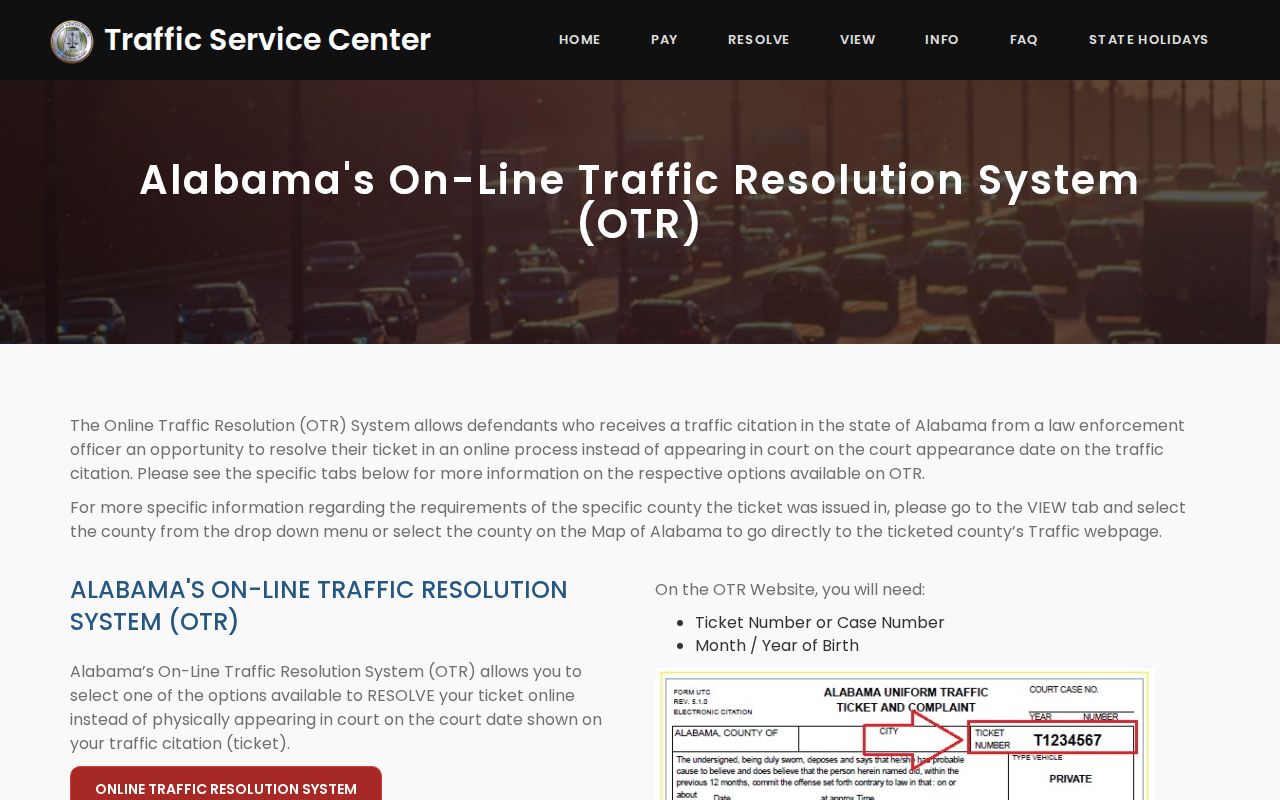
Those fields tie one known ticket to conditional court choices. They are not a search of every open Clay County warrant.
How to Pay or Lift a Traffic Warrant
Start with the issuing clerk. The court controls both the warrant and the case underneath it. Ask whether payment is still allowed, whether the judge requires an appearance, or whether an online request for a new setting is open. Clay County publishes no warrant-recall form, fixed warrant bond amount, guaranteed walk-through plan, or clearance time. Ask before assuming. A payment receipt alone will not lift a warrant that already issued, because only the court can recall it.
- Give the issuing clerk the exact ticket or case number and ask for the present warrant, FTA, and balance status.
- Follow the court's case-specific direction to pay, request a new date, appear, submit proof, or address bond.
- Keep the receipt, filed request, or signed court order and ask when the warrant record will show recalled or served.
- If ALEA received a suspension notice, ask the clerk whether a clearance notice must be taken to ALEA after compliance.
Warning: Payment does not prove a Clay County traffic warrant was recalled; obtain direct court confirmation and keep the written receipt or order.
Clay County Traffic Warrant Missed-Date Path
Missed the court date? Online Traffic Resolution can then show a different menu of choices. The state's option I path may appear after the date, with boxes for "License is Suspended," "Active Warrant," or "Other Outstanding Case(s)." The person gives a reason and, where an option is allowed, signs with the full legal name before sending the request. Sending it changes nothing by itself. The request asks the court to act. A safe Clay County sequence runs this way: missed date, check the known citation, send only an offered request, then call the clerk and verify the court's response. If the portal offers no choice, contact the court rather than trying unrelated payment pages. In a serious case, an attorney can ask about a new setting, surrender, or other action. Clay County runs no traffic-warrant amnesty event. It posts no safe-surrender week either. Standard court instructions remain in force unless a dated official notice says otherwise.
Traffic Warrants, FTA, and License Holds
One unpaid Clay County ticket can spawn several records. Each record means something different. Failure to appear, or FTA, is the missed obligation itself. A traffic warrant is court process that can authorize arrest. An ALEA suspension is a state action based on notice from the court, so keep the terms apart when asking the clerk what remains open.
| Mechanism | Trigger | Best confirmation |
|---|---|---|
| Traffic warrant | Court action after an unresolved citation or missed appearance | Issuing District or Municipal Court |
| FTA status | A required court response or setting was missed | Case docket and issuing clerk |
| ALEA suspension | Qualifying court notice under Alabama law | Court clearance notice and ALEA |
The local warning also flags a higher fine and possible bond forfeiture. Clay County treats those as case outcomes, not warrant status, so ask about each item by name.
Clay County Traffic Warrant Clearance Notice
Paying is not always the last step in Clay County. After the court accepts compliance, the clerk may need to issue proof. The official traffic instructions say a person with a suspended license may have to obtain a clearance notice from the Circuit Clerk and deliver it to ALEA. That step stands apart from paying the ticket. It also explains why a portal receipt and a state record may not update at the same moment. Ask the clerk four direct questions. What order resolved the case? Was the warrant recalled? When did the court send its ALEA notice? Must the person carry or deliver a clearance form? Keep a copy of each answer. For an Ashland or Lineville case, put the same questions to the municipal clerk and ask whether the city sent any required record to the state. Clay County publishes no fixed update interval, so written proof from the issuing court is worth more than guessing when a screen will change.
Clay County Traffic Warrant Status Terms
Clay County records use short labels for different stages. Alabama fee provisions also say "alias or capias warrant of arrest." Clay County publishes no local capias-pro-fine system, so the court's own label controls.
- Failure to appear
- The required response or court setting was missed.
- Writ of arrest
- Court process that may follow nonappearance or failed service under Alabama Rule 3.1.
- Recalled
- The issuing court withdrew the warrant; ask for the written court action.
- Bond forfeiture
- The court process seeking a posted bond after a missed appearance or breach.
- Clearance notice
- Court proof that may be needed for ALEA after the cited person complies.
No online result can prove a person is warrant-free in Clay County. The citation, the issuing clerk, the written order, and any ALEA follow-up form the full record of resolution.