
Checking for a Warrant in Clay County
Clay County publishes no online sheriff warrant list. The county's Magistrates and Warrants office gives one rule instead. Anyone who suspects a county arrest warrant must appear in person at the Clay County Sheriff's Department. That instruction covers county felonies, non-municipal misdemeanors, county traffic matters, and worthless-check complaints within the magistrate's stated jurisdiction. Ashland and Lineville municipal cases fall outside it. Check the city court that received the ticket or misdemeanor case on its own. Before contact, gather the full legal name, date of birth, and case or ticket number. Bring the place of the event too, plus any court paper. Photo identification is prudent for an in-person inquiry, though the Clay County page sets no ID rule. Call ahead for access needs. Do the same when city-versus-county is unclear. A blank result is never a clearance.
- Identify whether the matter began with the county, Ashland, Lineville, or a state traffic citation.
- For a suspected county arrest warrant, follow the official instruction to appear at the Sheriff's Department in person.
- Ask the Circuit Clerk for traffic, circuit criminal, district criminal, or warrant-information routing and use the courthouse public computer when needed.
- For an Ashland case, use the city-linked nCourt route and confirm status with the municipal clerk.
- For a Lineville case, use the municipal portal and its citation-number or birthday search before calling the clerk.
- For state traffic, use Online Traffic Resolution and the Traffic Service Center, then ask the issuing court what remains open.
- For a releasable sheriff-held record, use a specific hand-delivered or mailed request, and get written proof after any payment, new date, bond, or recall.
Clay County's No-List Warrant Rule
Clay County posts no public active-warrant roster. No warrant app, county search form, or most-wanted list appears either. That silence concerns access only. Warrants can still exist, so it proves nothing either way. Phone confirmation is not promised either. The sheriff's main number is just a contact route. The official court instruction still sends anyone with a suspected county warrant to the sheriff in person. The county's own warrant page explains why. An unserved arrest warrant is not public record. A sealed matter, a juvenile file, a new warrant, or a municipal case can all drop out of a public court view. Alabama agencies share law-enforcement reporting systems, but the state offers no public active-warrant search. Read each negative result in context. Note: no online result proves a person has no Clay County warrant; confirm with the sheriff and issuing court.
Clay County Warrant Types
A warrant's name reflects why the court issued it. A new criminal accusation follows a sworn probable-cause path before a judge. Miss a court setting, though, and a bench warrant or writ of arrest may follow. So can an unresolved traffic ticket. That route also risks a separate ALEA license action. Search warrants differ. One issued under Alabama Rule of Criminal Procedure 3.8 authorizes a search for evidence, not a name-based arrest lookup. Clay County records may use "alias" or "capias" for a later arrest process, but the local public pages describe no Texas-style capias pro fine.
| Warrant Type | How It Arises | Issuing Authority |
|---|---|---|
| Arrest warrant | Probable cause, indictment, complaint, or sworn testimony supports an arrest. | Clay magistrate, judge, or municipal judicial officer with jurisdiction. |
| Bench warrant or writ | A person fails to appear, a summons fails, or the court orders later arrest process. | The judge or court handling the case. |
| Traffic warrant | A ticket is not resolved and the required appearance is missed. | Clay District Court or the proper municipal court. |
| Search warrant | Probable cause supports a search for specified property or evidence. | A judge or magistrate under Alabama Rule 3.8. |
Clay County Magistrate Warrant Path
It starts with a report. Take the matter to the Clay County Sheriff's Department or to the police agency for the place where the event occurred. The complainant or officer then brings the report to the warrant-magistrate process, completes an affidavit, and answers questions under oath. Felony reports add a step. An investigator from the municipality or sheriff accompanies the complainant or officer to the clerk and magistrate stage. The magistrate then makes an independent probable-cause decision. If probable cause exists, an arrest warrant issues. The official page says issuance is free. It also warns that a charge cannot simply be dropped on request before court. Ashland and Lineville city misdemeanors and traffic cases take a separate municipal route. One office cannot answer every Clay County warrant question.
Report → sworn affidavit or deposition → magistrate review → warrant decision → service and return → court case.
Inside a Clay County Warrant Record
A court-held Clay County warrant record can name the court, the alleged offense, issue and service events, bond terms, and current status. The county publishes no sample warrant. It lists no local warrant-number format either. Guessing an identifier is a poor way to find the right court. Copy the citation number, case number, or warrant number exactly from your own paperwork. Hand it to the clerk when asking for a record match.
| Case or warrant number | The court's identifier, if one was assigned and is available. |
|---|---|
| Issuing court | Circuit, District, Ashland Municipal, or Lineville Municipal Court. |
| Charge source | Complaint, affidavit, deposition, indictment, citation, or related order. |
| Dates | Issue, service, return, booking, court setting, or recall dates shown by the record. |
| Bond or release | Any recognizance, appearance-bond, security, or court-set condition. |
| Status | Whether the process is served, recalled, quashed, withdrawn, or otherwise closed. |
Some fields stay private. Clay County states that an unserved arrest warrant is not public until service, and juvenile law-enforcement records carry separate limits.
Clay County Clerk Warrant Routing
The Clay County Circuit Clerk wears two hats. The office is record keeper and business manager for both Circuit and District Court, and its directory routes traffic, circuit criminal, district criminal, and warrant information through the same court operation. Call 256-354-7926 for the general office. The listed specialist routing is 256-252-4193. Court records also live on the courthouse public-access computer. Eligible users can also use Alabama's paid Just One Look service. The official Clay County office directory shows how these record divisions share the clerk's contact path.
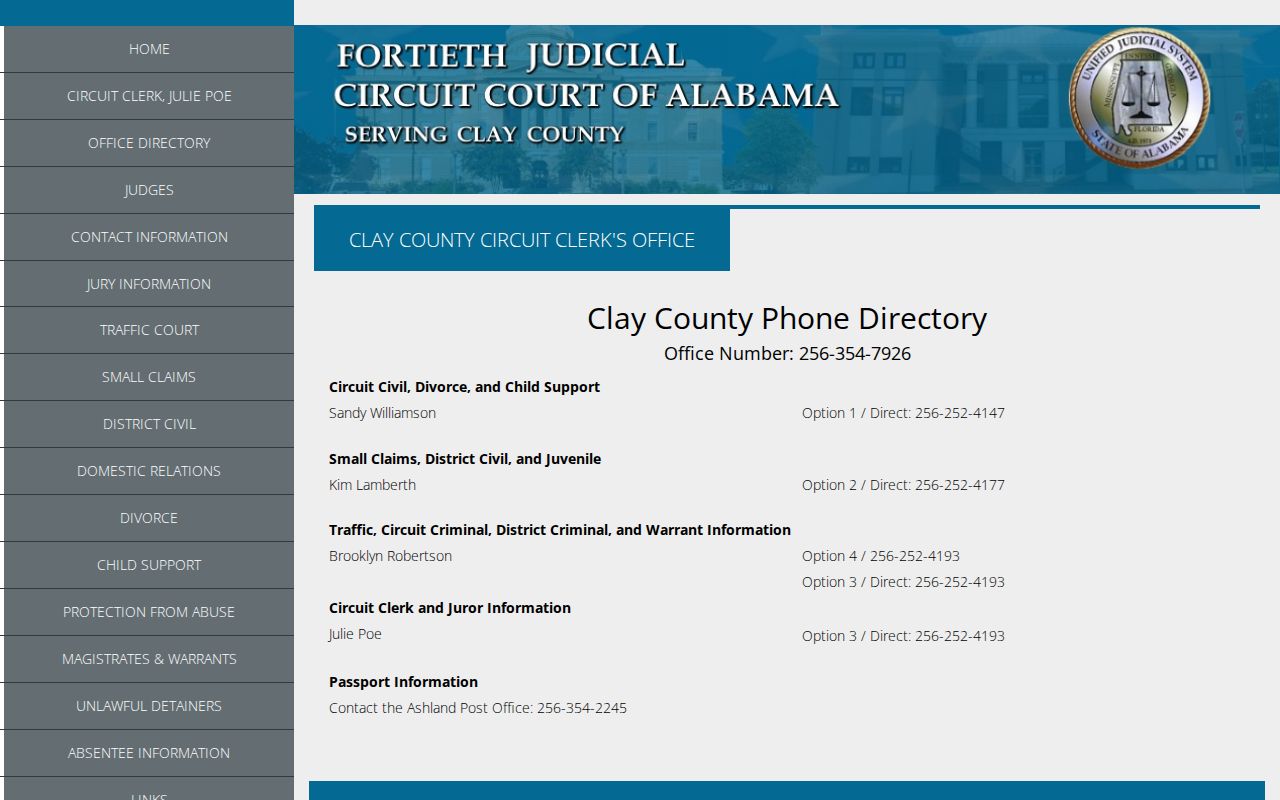
The directory helps with routing. It does not replace the sheriff's in-person instruction for a suspected unserved Clay County arrest warrant. Mail goes to the clerk. Use the Clay County Circuit Clerk, P.O. Box 816, Ashland, AL 36251, for court records and traffic correspondence. No fee, response time, or online request is posted.
Issuing and Serving Warrants in Clay County
Judges and magistrates issue Clay County warrants; deputies and police officers serve them. The Fortieth Judicial Circuit handles felony work. Clay District Court covers district criminal cases and county traffic matters. Ashland and Lineville Municipal Courts run their own traffic, ordinance, and misdemeanor dockets. Service gets documented through a return or a later case record, subject to access limits.
The sheriff is the main county service and booking channel. City police handle municipal reports and serve process within their roles. ALEA receives qualifying law-enforcement and traffic notifications, but its agency system is not a public Clay County lookup. The practical flow is court or magistrate → sheriff or city police → detention or appearance → clerk record of the return, bond, or recall.
Clay County Sheriff's Department
41771 Highway 77 North, Suite 2
Ashland, AL 36251
256-354-2176
Clay County Circuit Clerk
25 Court Square, second floor
Ashland, AL 36251
256-354-7926
Official Clay County court record office
Clay County Courthouse Warrant Access
The Clay County Courthouse sits at 25 Court Square in Ashland. Clerk hours run 8:00 a.m. to 4:00 p.m., Monday through Friday. The Circuit Clerk works from the second floor and keeps a public-access computer for court-record searches. Anyone who cannot reach that floor can call 256-354-7926 to arrange help. Built in 1906, the Neoclassical structure is described by the Alabama Administrative Office of Courts as the state's highest-elevation courthouse. The official courthouse page posts the contact block, hours, and public computer notice.
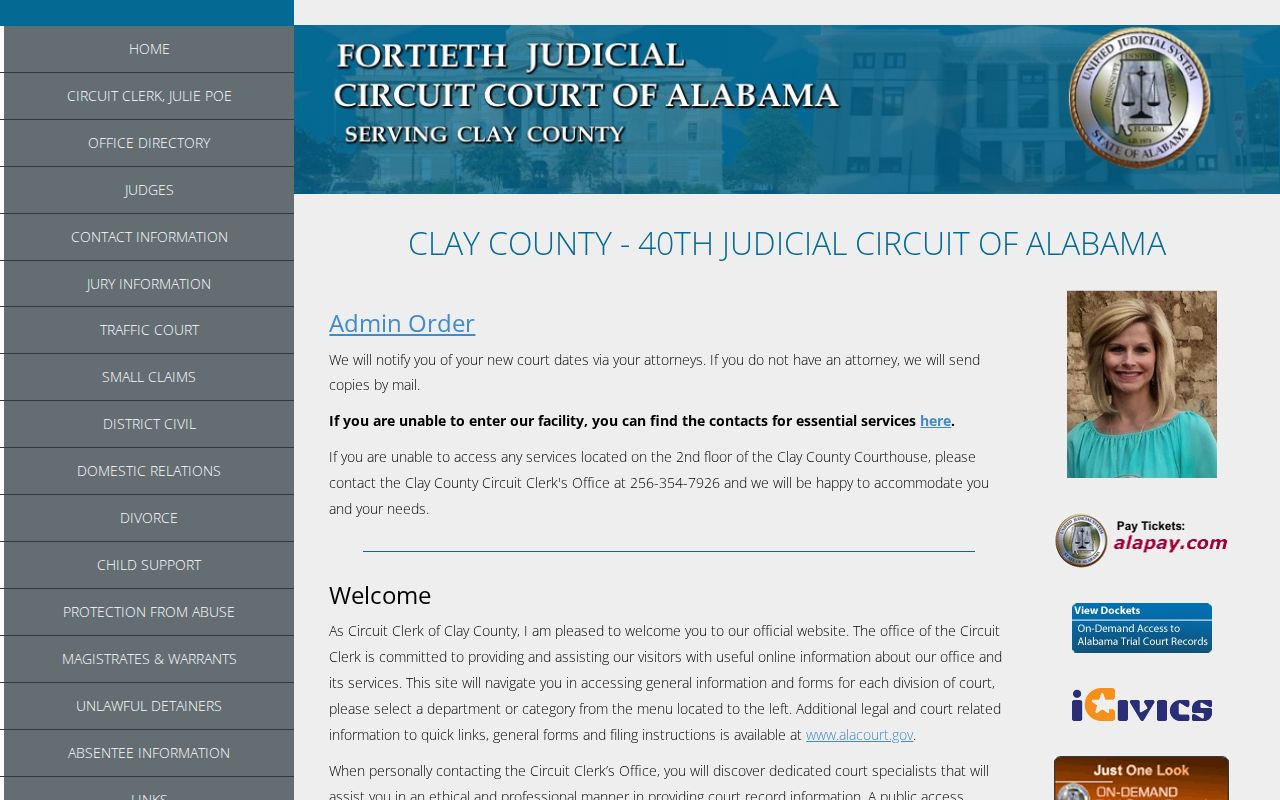
That courthouse route suits docket and served-record digging. A suspected Clay County arrest warrant still needs the sheriff's separate in-person instruction.
If You Have a Warrant in Clay County
Figure out which court issued the Clay County warrant and call that court first. The judge may want a new date, a payment, a bond, or an appearance. Some cases call for a surrender plan or an attorney-filed motion. Clay County posts no recall form, walk-through program, local bond schedule, or guaranteed no-booking surrender process, so do not assume a phone call or an online payment ended anything. Alabama Rule of Criminal Procedure 7.1 lays out the release options a judge can use, from personal recognizance and appearance bonds to secured bond, cash or certified funds, and surety. The terms stay case-specific. Clay County publishes no warrant bond amounts, bond-window payment methods, approved bond companies, or warrant intake hours. A lawyer can reach the issuing court and arrange a safe response, but only a court order or a confirmed status change proves the warrant was recalled.
Important: Speak with an Alabama lawyer before surrender or travel, and obtain written court proof after any recall, bond, or new setting.
Still, an active one can get you arrested at a traffic stop or anywhere else. Skip a court date on a ticket and the stakes climb fast: higher costs, bond forfeiture, even an ALEA license suspension.
Clay County Traffic Warrant Chain
Get a ticket in Clay County from a state trooper or a county deputy? That case belongs to District Court. The date printed on the citation is when you must appear, not when a trial starts. Pay it, resolve it, or show up. Clay's Traffic Court page warns that a warrant may issue if an eligible citation sits unresolved and you miss the date. The fine can rise, posted bond may be forfeited, and ALEA may suspend your license. Before that appearance date, eligible matters can be settled with a signed guilty plea mailed to the Circuit Clerk by money order or cashier's check, through AlaPay, or by card at 877-252-7294. Personal checks are not accepted. The Alabama Traffic Service Center at 866-954-9399 fields traffic questions. Its Online Traffic Resolution tool takes the ticket or case number plus your month and year of birth. After a missed date, the same site's conditional path may let you request a new one. One caution: paying does not automatically lift the warrant. Ask the court to confirm the warrant status, and ask whether you must take a clerk clearance notice to ALEA.
Clay County Warrant Records and Public Access
Alabama's Public Records Law gives state residents a general right to inspect or copy public writings, though exceptions and the custodian's own procedures apply. Sheriff-held records can be requested by delivery or mail. Court records go the judicial route through the Circuit Clerk and the Alabama court systems. Any request should name the precise record, the case or warrant number if you have it, the issuing court, the date range, the format you want, and your contact information.
Key rules:
Code of Alabama §36-12-40 gives Alabama residents a general public-writings right while treating judicial records separately.
Code of Alabama §36-12-45 permits custodian forms and methods, with hand delivery or mail as the baseline absent another procedure.
Code of Alabama §12-15-134 restricts juvenile law-enforcement records except where a legal exception or court order applies.
Some Clay County material stays closed: active investigations, sealed files, unserved warrants, juvenile matters, and protected personal information. The sheriff publishes no copy fee, turnaround time, or local appeal route, so confirm those details with the record custodian directly.
Clay County Warrant Status Terms
Status words track what happened to process after it issued. They don't all mean the same thing. Whatever the court's entry says controls. Ask the issuing clerk for the current term, its effective date, and written proof.
- Active or outstanding
- The warrant has not been served, withdrawn, recalled, or otherwise closed, though Clay publishes no full public list.
- Served
- An officer executed the warrant or the person was processed on it.
- Recalled
- The issuing court withdrew the warrant. The clerk should confirm the order.
- Quashed
- A court set aside or invalidated the warrant or order.
- Writ of arrest
- Court process directing an officer to arrest and bring the defendant before the court.
- Failure to appear
- The person did not attend as required by a ticket, summons, bond, or court order.
"Cleared" may just be an administrative label. Don't assume it applies because a Clay County record vanished from an online screen.
Clay County Custody Roster Limits
The sheriff's current-inmate roster shows custody, not a complete list of Clay County warrants. Its fields list an update time, a photo, name fields, age, sex, booking date, race, height, and weight. Every field describes someone already in custody. What the roster cannot show is the wider picture: unserved arrest warrants, city bench warrants, sealed matters, or status changes that live only with the court. A served warrant may show up later in booking or case information. That still doesn't turn a custody roster into a warrant search. Copying names, photographs, or individual roster details into any Clay County warrant record reference serves no one. Read the roster for what it is: a snapshot of current custody, not the list of outstanding judicial orders.
Clay County Warrants by City
Clay County contains just two incorporated cities, Lineville and Ashland, and Lineville is the larger of the pair by 2020 Census population. Each runs its own police department and municipal court. Those city courts take traffic tickets, ordinance violations, and misdemeanors inside their limits. The county magistrate has no say over those cases. So start a city warrant question at the Lineville or Ashland court or police desk, then ask the county sheriff whether anything was transferred.
Lineville Warrant Search
Population 2,489 · Lineville Police Department and Lineville Municipal Court route city cases and citation searches.
Ashland Warrant Search
Population 1,984 · Ashland Police Department and Ashland Municipal Court maintain separate city-case routes.
The 2020 Census supplies the population figures. They say nothing about Clay County warrant counts. Neither city posts an official most-wanted roster.