
Clay County Municipal Court Warrants
Two incorporated cities in Clay County run their own police and municipal court channels: Ashland and Lineville. Their courts take city traffic citations plus municipal misdemeanors and ordinance matters. Miss a court date, ignore a summons, or leave a citation unresolved, and the judge can issue a bench warrant, a writ of arrest, or straight arrest process; the issuing court picks the label. City cases start somewhere other than county cases, and the Clay County Magistrates and Warrants page says so plainly, excluding misdemeanors and traffic matters within Ashland and Lineville from its scope. That page also notes an unserved county arrest warrant stays out of public view until served. Put those rules together with the separate city dockets and one thing becomes clear: no online result clears you on a Clay County municipal warrant. A citation lookup may point you to a case or a payment path, but only the city clerk can tell you whether a warrant is active and what the judge requires to recall it.
Clay County Municipal Warrant Jurisdiction
Jurisdiction is just the court's legal power over a place and a type of case. In Clay County, that splits fast. Ashland Municipal Court holds tickets and misdemeanor arrests made by Ashland Police. Lineville Municipal Court holds its own city traffic and municipal cases. State trooper and county deputy traffic citations belong to Clay County District Court, while felony and other county criminal work runs through the Circuit or District Court and the sheriff. Your ticket, complaint, or release paper usually names the court; when it does not, the city where the event happened plus the citing agency tells you which clerk to call. The Clay County traffic warrant search route offers more help sorting District Court from the two city courts. A city clerk may mention that a warrant went to the sheriff or another agency for service, yet the issuing municipal court still controls recall and how the case ends. Alabama statutes sometimes say "alias or capias warrant of arrest" in court-cost provisions, but Clay County's own sources use arrest warrant, bench warrant, or writ of arrest, not any Texas-style capias-pro-fine product.
Clay County Cities With Municipal Courts
In Clay County, only Ashland and Lineville have documented municipal court and police channels. Check each court on its own. The phone numbers below are clerk contacts, not promises of warrant clearance by phone, and either court may insist on a personal appearance or action by the judge.
| City | Municipal court | Warrant types | Phone |
|---|---|---|---|
| Lineville | Lineville Municipal Court | City traffic, municipal misdemeanor, FTA or related court process | 256-396-2632 |
| Ashland | Ashland Municipal Court | City traffic, misdemeanor or ordinance, FTA or related court process | 256-354-2112 |
Population rank changes nothing about jurisdiction in Clay County. Lineville is the larger city in the 2020 Census. Still, the event location and issuing agency decide which court holds the municipal warrant record.
Clay County Municipal Warrants in Ashland
In Clay County, the Ashland Municipal Court Office handles every traffic ticket and misdemeanor arrest made by Ashland Police. It keeps the case records and dockets, collects fines, costs, and restitution, and forwards required records to ALEA. Court convenes at the Wynn Building, 45 2nd Avenue North, at 2 p.m. on the second Monday of each month unless a holiday shifts the schedule. For a Clay County municipal case in Ashland, Clerk Robin Catrett can be reached at 256-354-2112 or ashlandcourt@outlook.com during weekday office hours of 8 a.m. to 4:30 p.m. The city's nCourt payment path runs through four stages: Citation Search, Terms Agreement, Payment, and Receipt. The official Ashland citation page names the court and lays out that staged process. Do not assume it accepts the same search fields as Lineville's portal, since its search fields load dynamically.
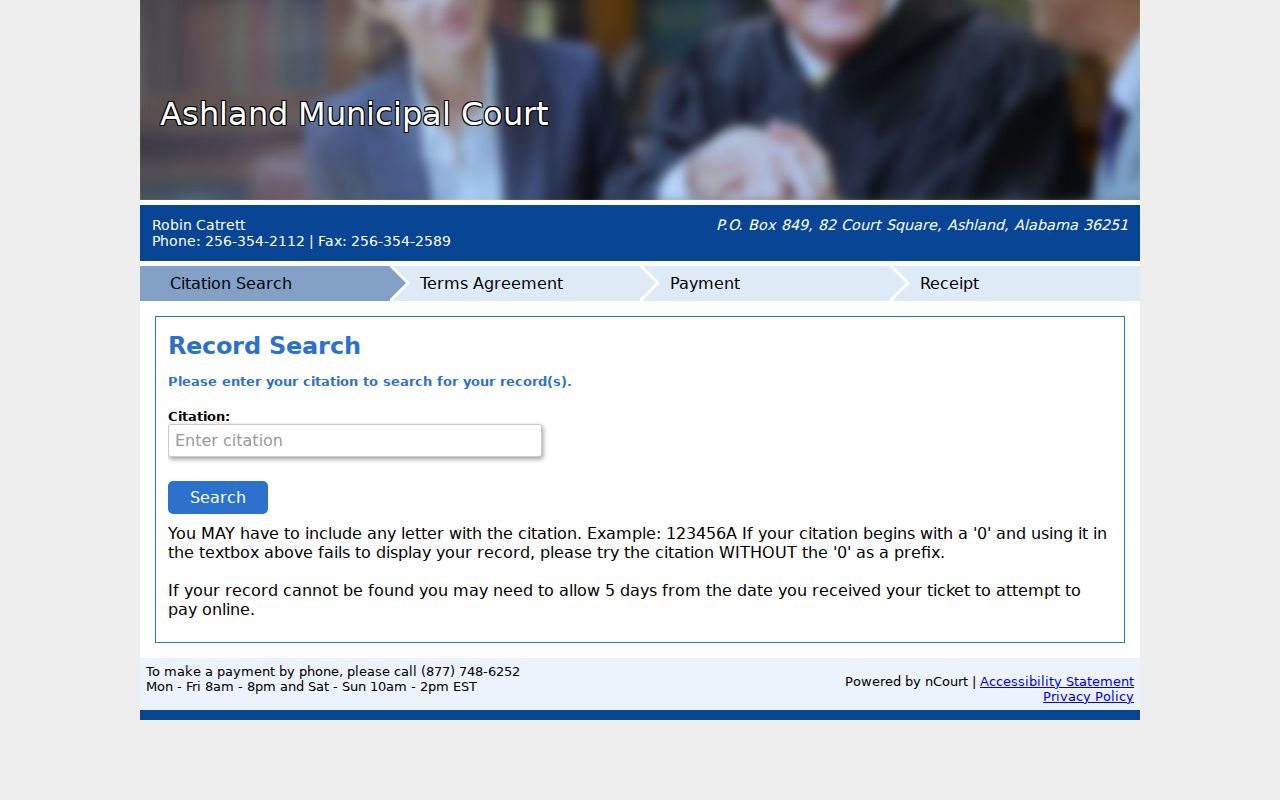
The stages end with a receipt. Even so, only the Ashland court can confirm whether your payment also caused the warrant to be recalled in Clay County.
Checking a Municipal Court Warrant
A Clay County municipal warrant check begins at the city court and widens only if that clerk points you somewhere else. Gather the person's full legal name, date of birth, citation or case number, city, citing police agency, and expected court date. Never enter private case data in an unofficial search. A payment screen is not a public warrant list.
- For Lineville, use the city-linked Government Portal with last name plus citation or case number, or last name plus date of birth.
- For Ashland, use the nCourt Citation Search path. Call the municipal clerk when the case is not found or the fields are unclear.
- Ask the correct clerk whether a municipal warrant, bench warrant, or writ is active and whether the judge requires payment, a new date, bond, or appearance.
- Use Ashland Police at 256-354-2122 or Lineville Police at 256-396-2633 for city police routing, not as proof that a warrant is absent.
- Visit the municipal court or city hall channel when the clerk requires in-person action. Confirm the time first, since neither city publishes a general walk-in warrant window.
- If the clerk identifies a county case, contact the Clay County Circuit Clerk at 256-354-7926 or 256-252-4193. Suspected county arrest-warrant status follows the sheriff's in-person route.
Put any Clay County written request for a city-held record in specific terms and follow the custodian's procedure. Neither Ashland nor Lineville publishes an online warrant-record request form, a response time, or a copy-fee schedule.
Clay County Municipal Warrants in Lineville
In Clay County, the Lineville Government Portal is the city's official citation and payment route. Its public search offers two modes. Both use last name. One adds a citation or case number; the other adds date of birth. Then hit the Search button. A login box sits on the page, but no account is needed for the public search.
| Search mode | Fields | What to confirm |
|---|---|---|
| Citation number | Last name plus citation or case number | Whether the result has any warrant meaning |
| Birthday | Last name plus date of birth | Whether more than one case matches |
| Clerk follow-up | Own identifiers and case details | Current warrant state and next court step |
The Lineville ticket search page lays out both Clay County tabs and their fields with no personal results shown.
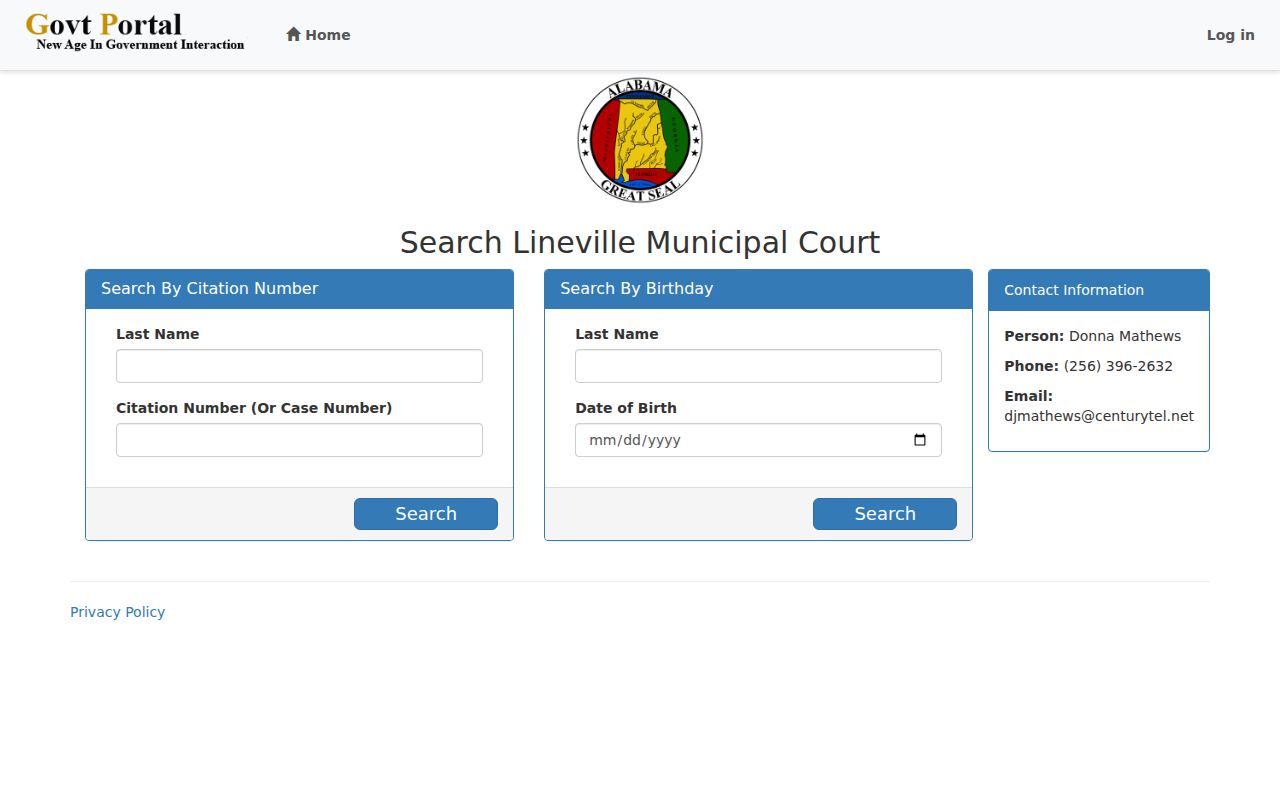
A Clay County portal hit means the system matched a municipal case. That alone proves nothing about whether a warrant is active, served, paid, or recalled.
Inside a Municipal Court Warrant
Treat a municipal warrant as one piece of its Clay County city case. The details that matter are the identifier, the issuing court, the citation or charge behind it, the court date, and the action pending now. Neither Ashland nor Lineville publishes a local warrant number format. So use the exact citation or case number the city court gave you. Never guess at a code pattern.
| Citation or case number | The municipal court identifier used to locate the city matter. |
|---|---|
| Issuing court | Ashland Municipal Court or Lineville Municipal Court. |
| Charge or ordinance | The city traffic, misdemeanor, or ordinance matter below the court process. |
| Issue and court dates | When the process issued and the setting that was missed or next assigned. |
| Amount or bond | Only the sum or release term set in that case; no countywide schedule is published. |
| Service and status | Whether the process is active, served, recalled, withdrawn, or otherwise closed. |
The Clay County portal can show payment data while leaving warrant fields blank. Have the clerk explain any missing status, and ask for the court's written action once the case closes.
Clay County Municipal Warrant Case Context
Case volume explains why the issuing city matters. The Alabama Administrative Office of Courts counts cases, not warrants. Its FY2025 report shows Lineville with more cases than Ashland, and both totals moved from FY2024. Those figures cover every reported municipal case in Clay County. They say nothing about open municipal warrants.
Clay County runs each city on its own docket. Records, schedules, and clerk answers stay separate. A Lineville portal result tells you nothing about an Ashland case, and an Ashland nCourt receipt tells you nothing about Lineville. Neither city publishes a municipal warrant total.
How to Resolve a Municipal Court Warrant
In Clay County, only the issuing city court sets how a municipal warrant gets resolved. The portal may take a payment, but neither Ashland nor Lineville promises that paying online recalls an active warrant. Neither city publishes a recall form, a warrant bond schedule, a payment-plan rule, a safe-surrender event, walk-in hours, or a fixed post-payment update window. Ask before you travel or pay.
- Confirm the city, case number, current warrant state, and any amount directly with the municipal clerk.
- Ask whether the judge permits payment, a new court date, bond, an appearance, or an attorney-filed request in that case.
- Complete only the action the issuing court approves and keep the portal receipt, clerk receipt, or signed order.
- Ask when the city warrant will show recalled and whether any service agency or ALEA record must also be updated.
Warning: An online city payment does not prove a Clay County municipal warrant was recalled; confirm the judge's action with the issuing clerk.
Clay County Municipal Warrant Clearance Proof
Written proof is what separates doing a task from knowing the Clay County court actually acted. Once you pay, get a new date, appear, post bond, or ask for a recall, request a receipt or order that carries the exact case number. Then confirm with the clerk that the municipal docket was updated and that any agency holding the warrant for service was notified. For Ashland, the nCourt process ends at a receipt, and the Municipal Court Office forwards required records to ALEA; the receipt documents a transaction, while the clerk can explain the warrant entry and any state notice. Lineville's city portal does not spell out what a search result means for a warrant, so clerk confirmation after payment is essential there. No official source gives a fixed clearance interval for a Clay County municipal warrant. A result vanishing from the portal does not mean the warrant is gone. Keep the court's written record and recheck with the same clerk.
Clay County Municipal Warrant Status Terms
Clay County city court staff may use several terms for related but distinct acts. Ask what the term means on that docket. Ask whether a judge has signed the order needed.
- Bench warrant
- Judge-issued arrest process tied to a court obligation or the kind of post-case event named by the court.
- Writ of arrest
- Alabama court process that may follow nonappearance, likely nonresponse, or failed summons service.
- Served
- An authorized officer executed the process or the person was handled on it.
- Recalled
- The issuing court withdrew the warrant; obtain the court's written action.
- Cleared
- An administrative status showing the process is no longer outstanding; local code wording is not published.
It is court process, an accusation at one stage of the case. The underlying charge still has to be handled in the issuing court.